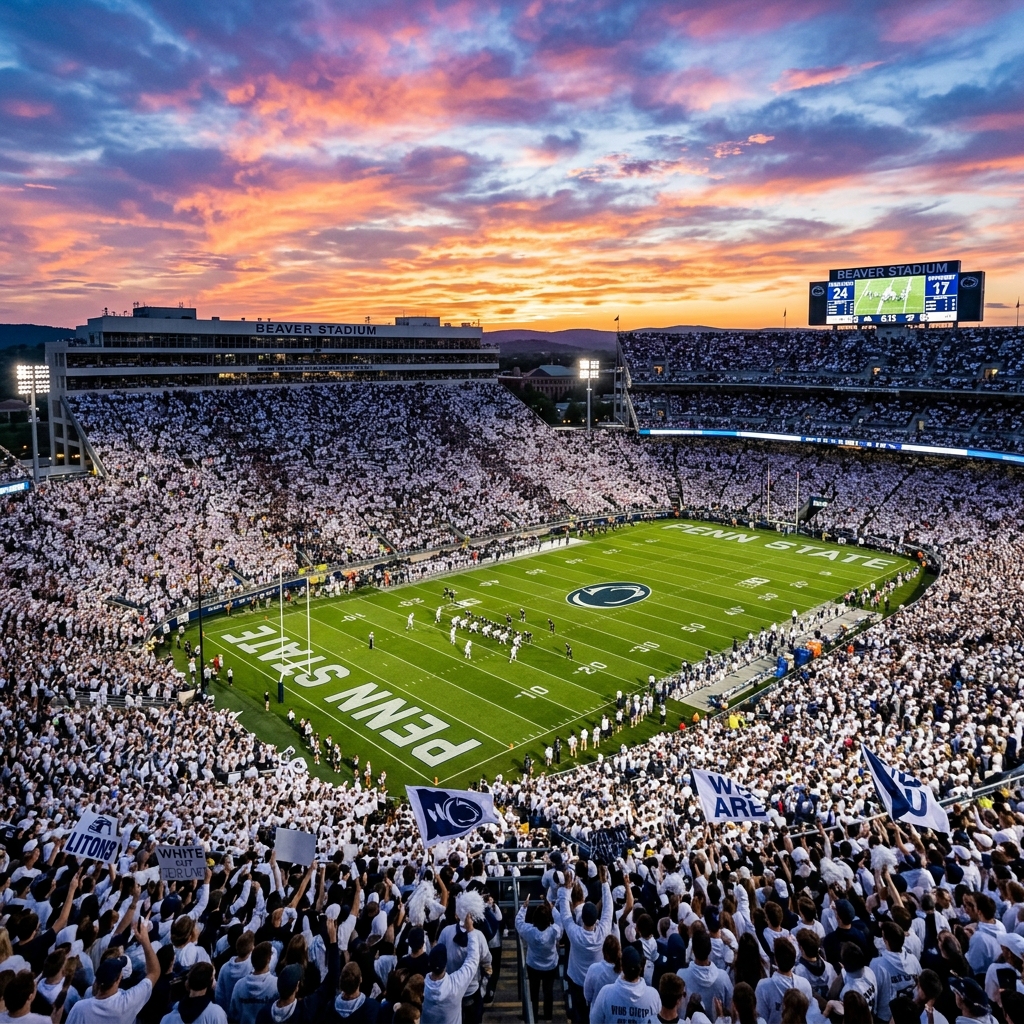
Penn State’s appearance at 2026 Big Ten Football Media Day produced something more useful than another speculative preseason depth chart: direct, attributable context from Matt Campbell, Rocco Becht, Anthony Donkoh, and Tony Rojas. Penn State Athletics published its Media Day coverage on July 28, and the Big Ten followed with its own conference profile on July 29.
Neither source published an official two-deep. The value is narrower and more practical. The interviews clarified Becht’s leadership role, Rojas’ public health outlook, the importance of offensive-line continuity, and how Campbell is framing the blend of returning Penn State players with a large Iowa State transfer group.
Those points support updates to the site’s 2026 Penn State depth chart, but they do not justify moving players solely because they spoke at Media Day.
1. Rocco Becht Is the Veteran Reference Point, Not a Finished Evaluation
Becht entered Penn State with the strongest starting resume in the quarterback room. The Big Ten credited him with 26 victories, more than 9,200 passing yards, 64 passing touchdowns, and 19 rushing touchdowns from his Iowa State career. Penn State’s roster biography provides the more precise passing total of 9,274 yards and records 39 consecutive starts.
Media Day added two pieces of context. First, Penn State reported that Becht’s participation had been limited during the spring. Second, Becht discussed the trust he has built with teammates and the responsibility he feels as an experienced quarterback. That combination matters: his prior production makes him the logical veteran leader, but the limited spring workload means his Penn State timing and receiver chemistry still need live evaluation.
The presence of 24 former Iowa State players also reduces some transition friction. Becht is not learning a completely unfamiliar offensive language, and several teammates already understand Campbell’s standards and parts of the system. That should help installation and communication. It does not guarantee that Penn State’s passing game will immediately reproduce Iowa State results against a Big Ten schedule.
The responsible depth-chart conclusion remains unchanged: Becht is the leading 2026 quarterback reference point, while Connor Barry and Alex Manske should be judged by fall reps and actual usage. The updated Rocco Becht profile separates his Iowa State career totals from his 2025 season and Penn State projection.
2. Tony Rojas Offered the Strongest New Health Signal
Rojas entered the offseason as one of Penn State’s most important defensive returners and one of its largest health questions. He had been working back from a significant knee injury, so spring descriptions properly treated availability and contact readiness as unresolved.
At Media Day, Rojas said he felt “more than 100 percent” and described himself as stronger and faster. That is the clearest public update since the spring. It supports moving the language from active rehabilitation uncertainty to improved health confidence.
It still needs a boundary. A player’s Media Day assessment is not a medical report, a snap-count promise, or proof that he will immediately handle every defensive package. Fall practice participation and early-game workload remain the evidence that can confirm his full return.
The Big Ten’s profile also supplies a useful career checkpoint: 105 tackles and four interceptions at Penn State. Those career totals should not be confused with his 2024 season line, when Penn State credited him with 58 tackles and three interceptions. Keeping season and career figures separate is essential on the updated Tony Rojas profile.
3. Anthony Donkoh Represents Offensive-Line Continuity
Donkoh’s Media Day appearance was meaningful because Penn State’s roster reset is not only about transfer arrivals. His comments focused on offensive line coach Ryan Clanton’s consistency and development approach, providing a returning player’s view of how the group is being built.
That does not settle the offensive line order. It does show why Donkoh matters to the board: he can connect returning Penn State experience with a staff installing new terminology and expectations. Offensive lines depend on communication, combination blocks, protection calls, and repeated work as a unit. Continuity has value even before a final five-man group is public.
For depth-chart tracking, the takeaway is to watch combinations rather than crown a complete line from interviews. Donkoh’s presence is an organizational signal. Fall availability, position usage, and the first game rotations must determine how strong that signal becomes.
4. Campbell Is Blending Systems Instead of Simply Recreating Iowa State
The 24-player Iowa State transfer group is impossible to ignore, but Media Day also highlighted the staff members and Penn State returners responsible for making the new roster function. Campbell discussed the importance of defensive coordinator D’Anton Lynn and associate head coach and cornerbacks coach Terry Smith. Rojas described Lynn as a coach willing to shape the defense around what players do well.
That is an important distinction. Penn State has substantial Iowa State familiarity on offense and across the roster, but the 2026 team is not a copy-and-paste version of Campbell’s former program. Lynn brings his own defensive background, Smith provides Penn State continuity, and position coaches such as Clanton must develop mixed rooms of returners and transfers.
The site’s Penn State coaching staff tracker therefore remains organized by responsibility, not just by names. Media Day reinforced the current role map, but it did not confirm every tactical detail or predict whether the new staff will succeed.
What Changes on the Depth Chart Now?
The best update is evidence-based and restrained:
- Becht remains the high-confidence veteran quarterback reference point.
- Rojas receives a more positive health note, with workload still unconfirmed.
- Donkoh becomes a clearer continuity marker for the offensive line.
- Campbell’s roster integration should be evaluated as a Penn State-specific build, not only an Iowa State reunion.
No position should be reordered simply because a player attended Media Day. The next meaningful evidence will come from fall practice availability, public staff comments tied to specific roles, and game participation when Penn State opens the season.
Sources and update notes
- Penn State Athletics: Nittany Lions at 2026 Big Ten Football Media Day, published July 28, 2026.
- Big Ten Conference: Penn State Football Media Day profile, published July 29, 2026.
- Career and season statistics are labeled separately. Interview comments are treated as attributed preseason context, not medical certification or guaranteed depth-chart outcomes.