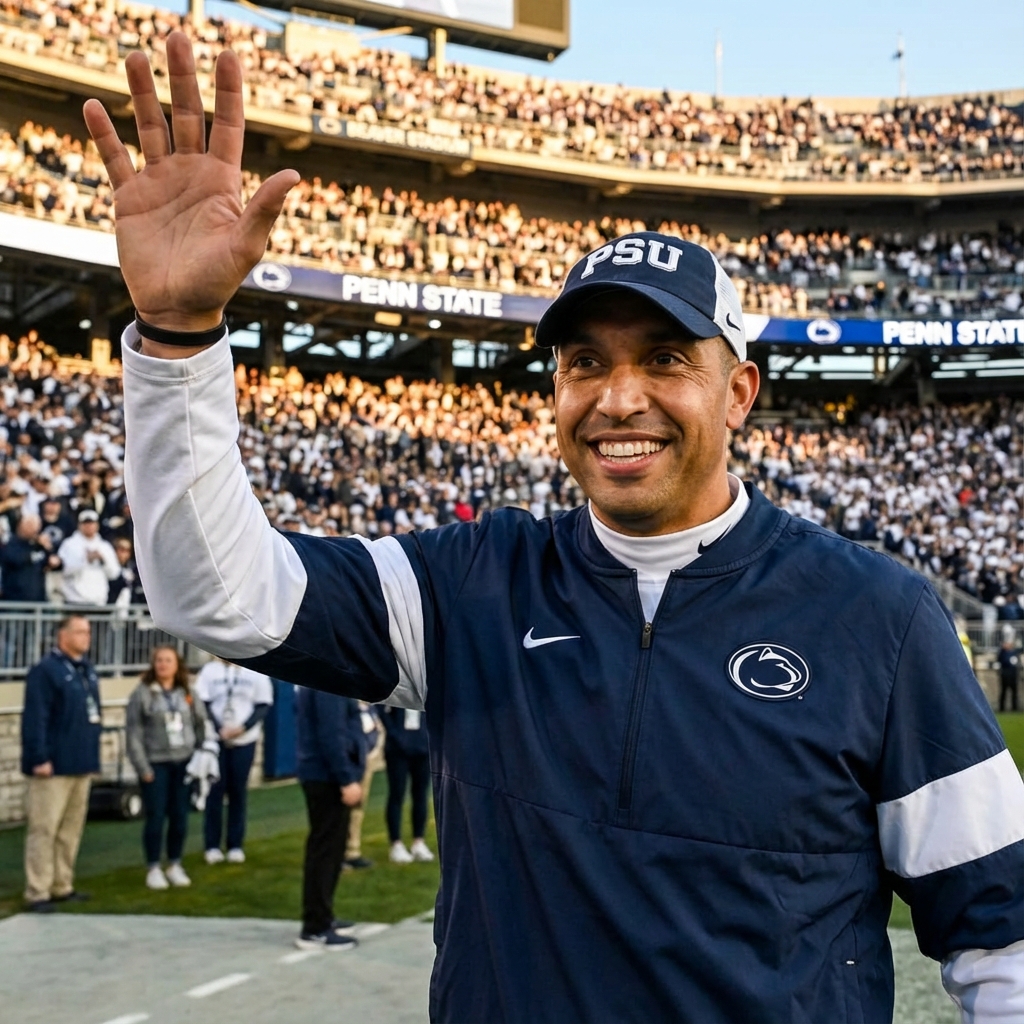
Penn State still needs recruiting wins in Pennsylvania, but Matt Campbell’s staff is also building a wider regional and national board. The 2027 commitments show how both approaches can coexist.
Penn State’s early 2027 commitment board changed by June 14: public reports said Semajay Robinson flipped to Virginia and Zachary Gleason Jr. flipped to West Virginia. Their spring pledges are historical context, not current Penn State commitments.
The In-State Question
Penn State’s recruiting identity under James Franklin was often summarized through the idea of controlling Pennsylvania. That made sense as a shorthand because elite in-state prospects carry both roster value and public symbolism.
The Campbell staff has not abandoned Pennsylvania. The clearest recent example is Stanley Montgomery, a four-star defensive lineman from Philadelphia who committed to Penn State on April 30, 2026. StateCollege.com reported that Montgomery ranked as a top-10 Pennsylvania prospect and one of the highest-rated players in Penn State’s 2027 class at the time of his commitment.
That commitment is enough to correct the old headline. In-state recruiting is not dead. It is one part of a broader board.
The Regional Expansion
The 2027 class also shows a wider map. StateCollege.com and ESPN commitment data list Penn State commitments from Ohio, Iowa, New Jersey, Florida, Minnesota, South Dakota, and Pennsylvania during the spring surge.
Kei’Shjuan Telfair from Ohio, Landon Blum from Iowa, Carter Blattner from New Jersey, Cooper Terwilliger from South Dakota, and other spring-cycle targets all fit the pattern. Robinson originally fit that broader map as a Florida commitment, but June reports said he later flipped to Virginia. The staff is not relying on a single state to carry the class. It is using existing Midwest ties, Penn State’s Northeast reach, and targeted national recruiting.
That is the real strategic shift. Campbell is not trying to win a slogan. He is trying to build a class from regions where the staff has relationships and where the player fits the roster plan.
Position Priorities
The early 2027 board is also heavy on defense and perimeter traits. Terry Smith’s work with defensive backs was visible in the spring commitments of Robinson, Zachary Gleason Jr., Ka’ron Ceaser, and Telfair, but Robinson and Gleason both require June qualifiers after later flip reports. Ikaika Malloe’s involvement with Montgomery points to a defensive-front priority.
On offense, Blum gives Kashif Moore an early receiver recruiting win after Moore became Penn State’s wide receivers coach. That matters because the 2026 roster reset made receiver development and evaluation a major issue for the new staff.
What To Avoid
It is too early to say Campbell has permanently changed Penn State recruiting before a full class signs. Lower-rated prospects are not automatically hidden stars; developmental recruiting has to be judged by what the roster eventually produces.
The accurate current framing is measured: Penn State’s 2027 class moved quickly in late March and April, included both in-state and out-of-state wins, and showed the staff using a wider map than a Pennsylvania-only model.
Current Takeaway
Penn State still needs Pennsylvania. The Montgomery commitment proves that. But the modern Big Ten recruiting map is larger, and Campbell’s early 2027 class reflects that reality.
The emerging board still includes in-state battles alongside Midwest and Northeast staff ties and selective recruiting in Florida and other national areas. Signed classes and later roster development will show whether that approach works.
Sources
This update was checked against StateCollege.com recruiting reports on the spring board; public recruiting databases; and local recruiting coverage from Black Shoe Diaries, including later June movement involving Semajay Robinson and Zachary Gleason Jr.